
I’ve been listening to Lider mit Palestine: New Yiddish Songs of Grief, Fury, and Love, an album of Yiddish music in solidarity with Palestine released this week. Across 17 tracks, a variety of musicians call for an end to Israeli atrocities, lament the blood that has been spilled, and envision the dawn of a new era of cooperation and solidarity among peoples—all in Yiddish. In the artists’ own words, the album comprises “original songs steeped in history and heritage and committed to a liberatory future … from a group of artists who refuse to accept a status quo of oppression and erasure, and who refuse silence.” Proceeds from the album benefit Gaza Birds Singing, “a musical, educational, and therapeutic project in Gaza.”
The highlight of the album for me is its eleventh track, “Goles-himen” (Diaspora Hymn), by Isabel Frey, Esther Wratschko, and Benjy Fox-Rosen. In a brilliant subversion of the Zionist metanarrative, which envisions diaspora as exile and the land of Israel as the true Jewish homeland, the song puts new Yiddish lyrics to the melody of “Hatikvah,” the Israeli national anthem. It opens with the well-known slogan of the Jewish Labor Bund, ideological antagonist of the Zionists in the late nineteenth and early twentieth century: “Wherever we live, there is our country.” Where the lyrics of “Hatikvah” express the hope “To be a free nation in our own land, / The land of Zion and Jerusalem,” “Goles-himen” intones: “Out from the prisons of all the nation-states / Jerusalem is all around” (aroys fun di turmes fun ale medines / umetum iz yerushalayim).
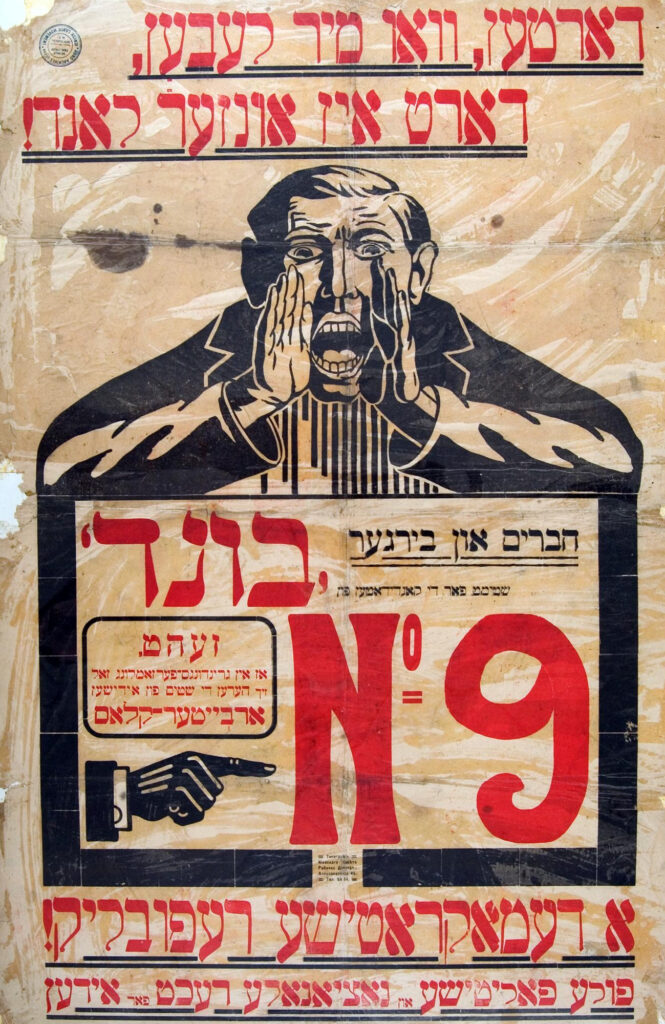

While listening, I couldn’t help thinking of Philip Roth’s novel Operation Shylock, in which a Roth doppelgänger travels around Israel preaching “diasporism,” fancying himself a kind of reverse Theodore Herzl who will lead the Jews back into exile for the sake of their moral and existential self-preservation. Roth, of course, is writing satire, but his fictional alter-ego is a device that allows him to indulge thoughts that until recently might have seemed heretical. In the face of the ascendance of the Israeli far right and its project of ethnic supremacy, however, many younger people with Jewish backgrounds are seeking ways to express their Jewishness other than through unwavering support for Israel. For many this means a return to diasporic thinking. As someone with one Jewish and one non-Jewish parent, the appeal of exile/diaspora for me is that it rejects the either/or logic of national belonging, which bases inclusion on narrow, supposedly immutable identity categories. The diaspora represents the freedom to mix—cultures, ethnicities, traditions, languages, nationalities—and thereby to create new identities and new traditions based on shared human experience.