My Favorite Books of 2025 and What I Plan to Read in 2026

I’m not sure how many books I read in 2025, but it felt like a lot. Below I’ve collected a few standouts. This list reflects my intellectual preoccupations: democratic socialism and social democracy, labor history, Yiddish and Yiddishkeit, and realism in art and literature.

Tomorrow’s Bread by Beatrice Bisno

Published in the 1930s, this proletarian novel is based on the life of the author’s father, Abraham Bisno, a Jewish immigrant to Chicago from Ukraine who became a prominent labor leader among the city’s garment workers. A consummate organic intellectual, Bisno was a militant strike leader and practical socialist with provocative bohemian proclivities. The novel narrates Bisno’s personal and family life and paints an evocative picture of Jewish immigrant life in Chicago at the turn of the 20th century, a subject I wrote about recently for the Newberry Library.

The Communist by Guido Morselli

I was blown away by this intensely philosophical and psychological portrait of the Italian Communist Party in the 1950s. Although it is a novel, the story is grounded in a real milieu and mixes factual people and events with fictional in a way that I found compelling and stimulating. I especially liked its reflections on the fate of labor in a socialist society, a seemingly abstruse topic on which the plot actually hinges.

Your Comrade, Avreml Broide: A Worker’s Life Story by Ben Gold, translated by Annie Sommer Kaufman

Originally serialized in the leftwing Yiddish newspaper Morgn Frayhayt, this short novel tells the story of Avreml, a Jewish immigrant to New York from a shtetl in Romania. The novel is divided into two parts: the first is a lively description of life in the old country, peppered with romance, duplicity, underworld thieves, and a knock-down, drag-out fight. When events drive Avreml to leave for the United States, he finds himself alone and alienated by his new surroundings, an exploited worker in the garment industry. Avreml discovers socialism and eventually joins the Communists, making great personal sacrifices for the movement. While I found the second half of the novel didactic and dogmatic—it would be interesting to contrast it with the novel mentioned above, which takes a much more skeptical perspective on communist politics—the first half was utterly enchanting, enlivened by artist William Gropper’s inimitable illustrations. Kaufman’s translation is so seamless that you hardly realize you’re not reading the original, and her introduction places the novel in social and historical context.

New Deal Art by John P. Murphy
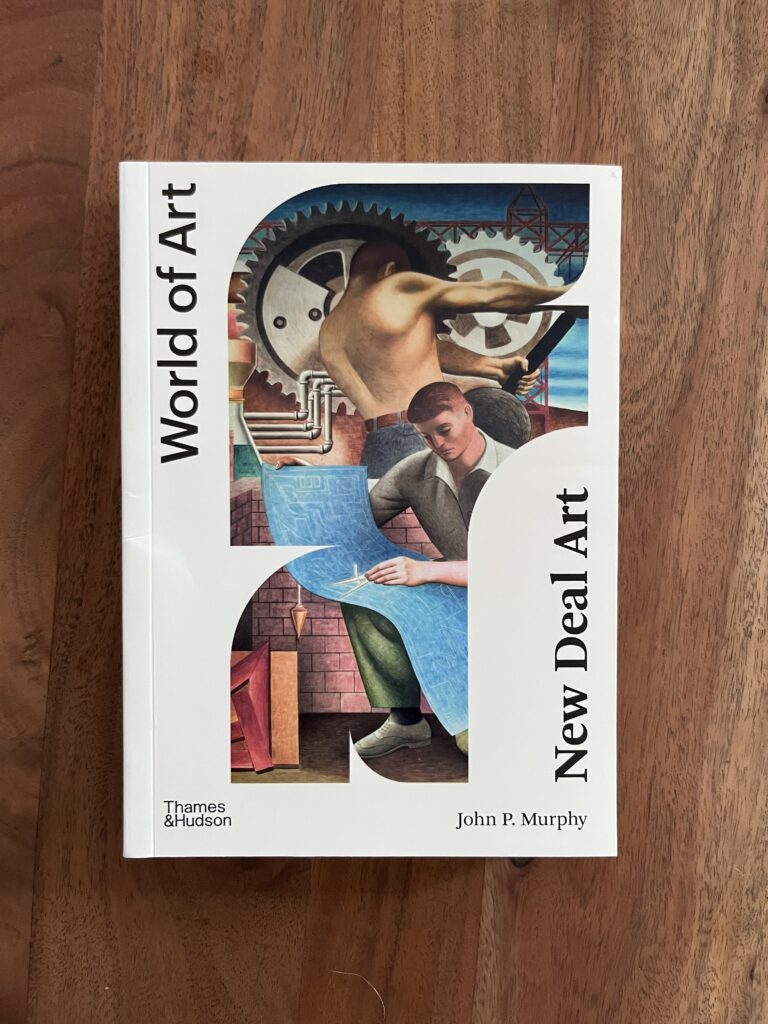
Written by my good friend and former Northwestern comrade, this handsomely illustrated survey is art history at its best. It offers a social, cultural, and institutional account of the era’s major artists and artworks, highlighting the diversity of New Deal artists while prompting the reader to consider the implications of the New Deal’s experiment in cultural democracy for today. I posted a short review of it on Amazon.

Salud y Shalom: Conversations with Jewish Veterans of the Abraham Lincoln Brigade by Joseph Butwin

A work of oral history, this book offers an unparalleled look at the personal and cultural factors that motivated American Jews to travel to Spain in the late 1930s and fight on behalf of the Spanish Republic against a fascist rebellion supported by Nazi Germany and fascist Italy. As these conversations reveal, Jewish volunteers—who made up around a third of those who joined the Republican cause from abroad—often came from families steeped in left-wing Yiddish culture. In other words, they had yikhes. Butwin conducted his interviews in the 1990s, when the veterans were still alive, and his book is notable among recent publications on the Spanish Civil War for containing so much first-hand testimony from the war’s participants, which it is no longer possible to gather. I hosted a book talk with the author for the Chicago YIVO Society in November.

Nordic Socialism by Pelle Dragsted

Drawing on the experience of the Nordic economies—where strong labor unions, state-owned enterprises, social democratic welfare states, and cooperative enterprises shape much economic activity—Pelle Dragsted, who represents the Red-Green Alliance in the Danish parliament, argues that it is possible to build a socialist society that avoids the pitfalls of the failed state socialisms of the twentieth century while still delivering a broad democratization of the economy. He envisions a pluralism of communal ownership forms that give ordinary people control over their lives while ensuring a high standard of living that is ecologically sustainable. I read Dragsted’s book alongside several other books about Nordic economic systems, including Viking Economics by George Lakey, Economic Performance in the Nordic World by Torben M. Andersen, and The Rise and Fall of Swedish Social Democracy by Kjell Östberg. One goal I have for 2026 is to write a review that addresses all these books together.

While Messiah Tarried by Nora Levin

I’m not sure why this book isn’t better known (although maybe I’m betraying my own ignorance). As a history of Jewish socialist movements, it covers much of the same territory as World of Our Fathers by Irving Howe and Prophecy and Politics by Jonathan Frankel, both of which are better known. What I liked about Levin’s book, which I finished in the waning hours of 2025, is its synoptic quality. Where Howe focuses on Jewish immigration to the United States and Frankel looks at Jewish socialism and nationalism in Eastern Europe, Levin brings these different strands together. She begins in the Russian Pale of Settlement, describing the conditions faced by Eastern European Jews, and covers Jewish immigrant socialist and labor movements in London and the U.S., the Bund in the Russian Empire, and the rise of socialist Zionism, ending with a chapter on Jewish-Arab relations in Palestine before the Balfour Declaration, a timely note on which to conclude.
I’m kicking off 2026 by diving into Sven Beckert’s new history of capitalism. I admired his earlier book, Empire of Cotton, and am looking forward to this one. At more than 1,000 pages, I think it should count as at least two books when it is time to tally the year’s reading at the end of 2026. A couple of other books I look forward to reading are Citizens of the Whole World: Anti-Zionism and the Cultures of the American Jewish Left by Benjamin Balthasar and Embracing Exile: The Case for Jewish Diaspora by David Kraemer.

Happy New Year, and happy reading!
“Like the story of the Exodus”: How Chicago’s Working-Class Jewish Immigrants Reacted to the Haymarket Affair

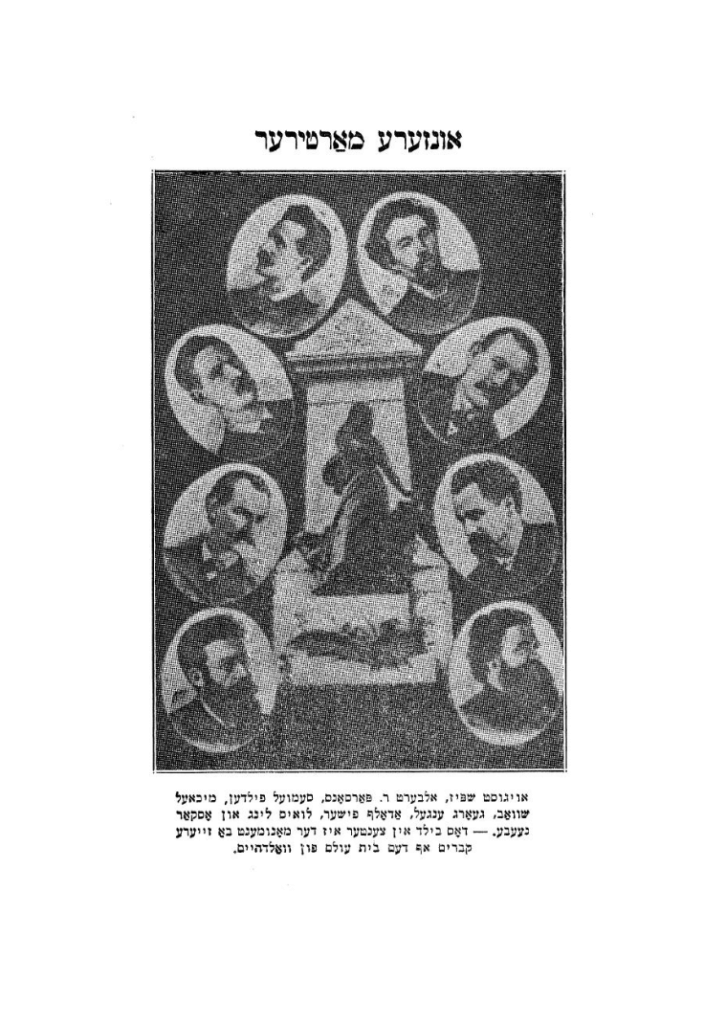
On November 11, 1887, August Spies, Albert Parsons, George Engel, and Adolph Fisher were hanged for their alleged role in the deadly Haymarket bombing, which occurred at a labor rally in support of the 8-hr workday in Chicago on May 4 the previous year. Although the identity of the bomb thrower was never established, Spies, Parsons, Engel, Fisher, and four others were tried for murder on the theory that their anarchistic ideas and activism, if not their direct actions, were to blame for the bombing. The trial came to be regarded as a travesty of justice; in 1893, Illinois governor John Altgeld pardoned the three surviving defendants.

In a forthcoming essay for the Newberry Library’s Digital Collections for the Classroom project, I discuss the effects of Haymarket on Chicago‘s Jewish immigrant community within the broader context of the city’s Jewish working-class history. (Update: the essay is now online.) Jewish immigrants from Eastern Europe, who began arriving in Chicago in large numbers just a few years earlier, were not directly involved in the events of Haymarket; nevertheless, they were profoundly influenced by them. (While Eastern European Jewish immigrants weren’t directly involved, it is notable that two of the lawyers who defended the accused Haymarket anarchists were Jewish, and one of them, Sigmund Zeisler, was a recent German-speaking immigrant from Austria.) For Abraham Bisno, a Jewish garment worker from Ukraine, Haymarket was a formative experience. A month before the bombing in April 1886, Bisno saw Spies give a German speech to a group of workers, which as a native Yiddish speaker he could understand. By his own account, the speech set Bisno’s mind “aflame” and opened his eyes to the nature of capitalism as an unjust, historically transient, class-based system that could be overcome through conscious social action. On May 5, 1886—one day after the bombing—Bisno and other Jewish tailors organized a march to demand better wages and working conditions. The procession was violently suppressed by the police as it crossed the Van Buren Street Bridge. In his autobiography, Bisno described the state of “martial law” that prevailed in the aftermath of Haymarket: “Labor unions were raided, broken up, their property confiscated, the police used their clubs freely. Arrests were made without any cause, and the life of the working man was not quite safe when out on strike.” Shaken but undeterred, Bisno and his comrades went on to organize the Chicago Cloakmakers’ Union, a forerunner of the International Ladies Garment Workers’ Union; in 1890, Bisno was elected the union’s first president.

Haymarket also made a strong impression on Philip Bregstone, a Jewish immigrant from a small town in what is today Lithuania (then Poland). Bregstone arrived in Chicago in the summer of 1887. The city was still reeling in the aftermath of the bombing and trial, and the defendants were still fighting their convictions in appeals court. Impressed by Spies’s fiery oratory, Bregstone said that he “hurled bombs at his enemy, the capitalistic class, not made of explosive chemicals, but bombs of logic and science” and “was an orator of dynamic force” who “spoke equally well in English and German.” In his 1933 cultural history, Chicago and Its Jews, Bregstone described how Haymarket planted the seeds for the city’s Jewish labor movement, leading directly to the formation of the Jewish Workingmen’s Educational Society. “It was there that the Jewish labor movement, Jewish radicalism, socialism and anarchism in this city, first saw the light of the day,” Bregstone wrote. The organization “established a modest library, conducted lectures and encouraged public speaking.” Bisno was one of the society’s leading members, as was Peter Sissman, a prominent socialist, lawyer, and associate of celebrated civil rights attorney Clarence Darrow.

Frontispiece from a Yiddish translation of the speeches of they Haymarket Martyrs, translated by A. Frumkin with a foreword by Alexander Berkman.

For Hilda Polacheck, who arrived in Chicago from Poland in 1892, several years after the events of Haymarket, the episode had already acquired an almost mythic status. In her memoir, she describes attending a Haymarket memorial meeting led by anarchist and fellow Jewish immigrant Emma Goldman in 1903. As an immigrant forced to work long hours in a knitting factory to support her family after her father died, Polacheck related to the events of Haymarket personally. “As I sat there listening to the recital of these events, I kept thinking of the shirtwaist factory and the hours I worked, and I could not get myself to feel that asking for the eight-hour day was a crime,” she wrote. Although she “was horrified at the throwing of the bomb” she was equally shocked by the state’s brutal suppression of labor activists. Her “father had come to America … because here in this wonderful country a man was free to say what he wanted, even if he was wrong.”

138 years later, the issues that animated the Haymarket affair and its aftermath remain relevant. People are still overworked and underpaid, immigrants continue to have their civil rights abused, and authoritarian politicians continue to threaten freedom of speech. At the turn of the twentieth century, members of Chicago’s Jewish immigrant working-class reacted to such abuses and indignities by joining with others to form a broad movement for democracy and labor and civil rights. For example, Bisno and Polacheck formed close relationships with Jane Addams and Hull House, forging coalitions to pass labor laws and support strikes from the 1890s through the 1910s, activities that helped pave the way for the social democratic reforms of the New Deal era. Their motivations were decidedly secular and political rather than spiritual or religious, yet Chicago’s working-class Jewish immigrants were still informed by a broader Jewish consciousness, which Emma Goldman alluded to when she said of the Haymarket affair, in Polacheck’s recollection, “that everybody in the hall knew the story of the martyred comrades, but like the story of the Exodus, it had to be told each year so that ‘we will not forget.’” Rather than looking to messiahs or prophets, however, they looked to themselves and their fellows to make a better world.

Lider mit Palestine—a Diasporist Plea

I’ve been listening to Lider mit Palestine: New Yiddish Songs of Grief, Fury, and Love, an album of Yiddish music in solidarity with Palestine released this week. Across 17 tracks, a variety of musicians call for an end to Israeli atrocities, lament the blood that has been spilled, and envision the dawn of a new era of cooperation and solidarity among peoples—all in Yiddish. In the artists’ own words, the album comprises “original songs steeped in history and heritage and committed to a liberatory future … from a group of artists who refuse to accept a status quo of oppression and erasure, and who refuse silence.” Proceeds from the album benefit Gaza Birds Singing, “a musical, educational, and therapeutic project in Gaza.”


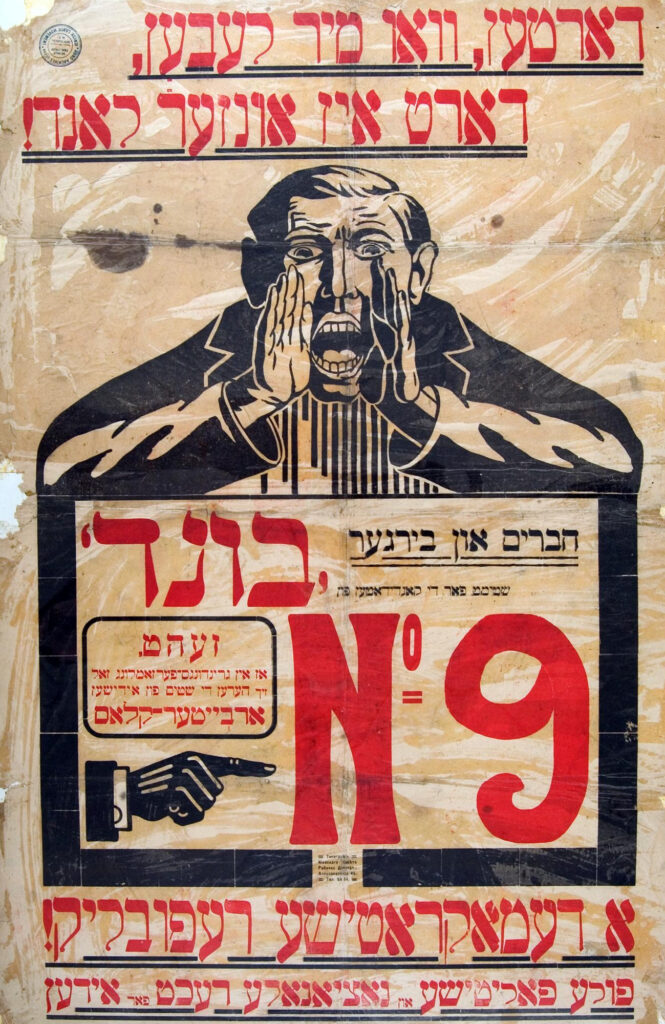
The highlight of the album for me is its eleventh track, “Goles-himen” (Diaspora Hymn), by Isabel Frey, Esther Wratschko, and Benjy Fox-Rosen. In a brilliant subversion of the Zionist metanarrative, which envisions diaspora as exile and the land of Israel as the true Jewish homeland, the song puts new Yiddish lyrics to the melody of “Hatikvah,” the Israeli national anthem. It opens with the well-known slogan of the Jewish Labor Bund, ideological antagonist of the Zionists in the late nineteenth and early twentieth century: “Wherever we live, there is our country.” Where the lyrics of “Hatikvah” express the hope “To be a free nation in our own land, / The land of Zion and Jerusalem,” “Goles-himen” intones: “Out from the prisons of all the nation-states / Jerusalem is all around” (aroys fun di turmes fun ale medines / umetum iz yerushalayim).

A Bundist election poster from circa 1917 sports the slogan: “Wherever we live, there is our country!” Public Domain via Wikimedia commons.


While listening, I couldn’t help thinking of Philip Roth’s novel Operation Shylock, in which a Roth doppelgänger travels around Israel preaching “diasporism,” fancying himself a kind of reverse Theodore Herzl who will lead the Jews back into exile for the sake of their moral and existential self-preservation. Roth, of course, is writing satire, but his fictional alter-ego is a device that allows him to indulge thoughts that until recently might have seemed heretical. In the face of the ascendance of the Israeli far right and its project of ethnic supremacy, however, many younger people with Jewish backgrounds are seeking ways to express their Jewishness other than through unwavering support for Israel. For many this means a return to diasporic thinking. As someone with one Jewish and one non-Jewish parent, the appeal of exile/diaspora for me is that it rejects the either/or logic of national belonging, which bases inclusion on narrow, supposedly immutable identity categories. The diaspora represents the freedom to mix—cultures, ethnicities, traditions, languages, nationalities—and thereby to create new identities and new traditions based on shared human experience.

A Yiddish Defense of Revolutionary Christianity


Bishop Mariann Edgar Budde turned heads at an inaugural prayer service earlier this week when she ended her sermon with a plea for returning president Donald Trump to “be merciful to the stranger” and “honor the dignity of every human being.” Budde’s plea evoked a proud Christian tradition of solidarity with the powerless and marginalized. While often downplayed in politically conservative strains of Christianity, that ethos lies at the historical foundation of the religion. Her reference to the “stranger,” moreover, recalled Jewish Passover traditions, which remind Jews to treat strangers with respect “for you were strangers in the land of Egypt.”

Jews have also been known to pen paeans to Christianity’s emancipatory theology, surprising as that may sound. Consider, for example, an article published in the Chicago-based, Yiddish-language newspaper Jewish Labor World in 1908 under the headline “Christianity as a Revolutionary Movement.” Besides presenting a polemical reading of Christianity as a radical movement of justice and equality, it is remarkable for appearing in a Yiddish newspaper—not the first place you’d expect to read an encomium on Christian values.

Jewish Labor World (Idishe Arbayter Velt in Yiddish) was founded in Chicago in 1908. While more obscure than the famous leftwing Yiddish newspapers of the day, such as the anarchist Fraye Arbeter Shtime (the Free Voice of Labor), Idishe Arbayter Velt nevertheless played a significant role in the development of the Jewish socialist and labor movement in Chicago and the wider United States. The paper was published as a weekly until 1917, after which it became a daily and merged with the better-known New York-based Forverts (Jewish Daily Forward). I encountered the paper through my research into Jewish Chicago at the Newberry Library. The article, which I’ve translated from Yiddish, was written by Hillel Rogoff, the Idishe Arbayter Velt’s first editor.

Front page of Jewish Labor World featuring an image of Eugene V. Debs, who ran for president on the Socialist Party ticket in 1908. Debs was famous for incorporating prophetic Biblical rhetoric into his speeches.

Christianity as a Revolutionary Movement by Hillel Rogoff

The original Christian ideas were revolutionary. The hope prevailed among the followers of the Christian religion that Jesus would soon return to this world with a great military force, and after a bloody war, he would destroy the Roman government and, in its place, found a state in which all people would live equally and fraternally.

Customarily, such a hope appealed strongly to the oppressed masses: the worse the poverty among the proletarians became, the more they were drawn to the Christian movement, which painted such a bright, lofty future for them.

The poverty at that time was the great social question in Rome. Even the Roman government took measures to alleviate people’s suffering. But the government couldn’t give out more than a little bit of aid, and what they gave hardly sufficed at a time when thousands of people were unable to find gainful employment of any kind. Many Roman intellectuals dismissed poverty as a harmless phenomenon. No help was to be found except for from the preachers of Christianity.

First, these Christians cast the whole blame for such troubles upon the ruling classes and awoke in the masses a feeling of revolution against these rulers. Further, they undertook practical work to help the poor. Whoever founded a Christian community took it upon themselves as their first duty to combat the poverty and need of the masses. They introduced communism into the provision of food. All who belonged to the same community ate from the same table and lived together fraternally. If there was one rich man in a community, the others did not lack. He shared each bite with everyone.

The Christian doctrines, the dogmas and ceremonies, did not at that time constitute the main point of Christianity. They were merely the clothes in which the noble work was clad. And because Christianity gave the masses something practical, because the poor man knew that being a member of a Christian community, he would at least not need to suffer any hunger, many thousands of proletarians joined up.

The article’s headline as it appeared in the pages of the Idishe Arbayter Velt on July 24, 1908.

It goes without saying that the Roman government considered these communities a great danger. They openly cursed the Roman aristocracy’s libertine lifestyles and blamed them for the troubles of the land. From the beginning, the government threatened the leaders and agitators and ordered them to stop their propaganda, but that was of little avail. To the contrary, with every day their numbers grew, and what’s more, they grew bitterer in their appeals to Roman society. The government saw that they could not achieve their goals with talk and orders alone, so they decided to drown the whole movement in a sea of blood.

This struggle of the Romans against the first Christians is one of the most appalling chapters of world history. Christians were persecuted with fire and sword. Every day, masses of them were thrown before hungry wild animals. They were forced to endure great suffering; they were routinely burned and roasted and torn limb from limb.

When trouble befell the land, Christians were blamed, and they had difficulty evading the charges. When the harvest was poor, the Roman army was defeated on the battlefield, or an epidemic broke out in the city, Christians were invariably scapegoated. The government already had its own hired servants who used to incite the blind masses in such times; they used to attack the weak, defenseless Christians and treat them a thousand times worse still than the Black Hundreds treated the Jews in the time of terrible pogroms. [The prior sentence is very hard to read due to the poor quality of the scanned microfiche, but I’m fairly confident it is accurate. Yiddish keners can correct me if I’m wrong.]

The Christian communities were strengthened by these persecutions, however. Thousands saw the government’s murderousness and began to sympathize with the persecuted. Gradually, the sympathizers were drawn to the Christian communities and became Christians themselves. Furthermore, the Christians held fast to their beliefs. For them, death was a game. Young girls used to endure burning and being torn apart by wild animals without so much as shedding a tear. Many considered it a blessing to die for God [kidesh hashem] because then the Church would recognize them as holy martyrs, for whom the doors of paradise are always open wide. The joy with which many used to sacrifice themselves for their religion drew thousands of fresh adherents, and Christianity increasingly captivated the better, noble children of the people.

By the dawn of the third century, Christianity had become a powerful force in Roman society. The government began to understand that to continue their struggle would endanger them more than it would the Christians. Thus, the persecutions gradually came to an end, and the government began to seek peace with the Christian communities. And from this very peace with Rome, developed the Christian Church, the dark power of the Middle Ages.

As long as the proletariat, the poor, oppressed worker, was its bearer and disseminator, Christianity remained true to its first principles. Then it was the preacher of revolution and the protector of the poor. As the government forged a partnership with the Christian faith and aristocrats began to adopt it as their own religion, however, Christianity took on a different guise.

The story that Jesus will soon return and introduce a free society where all will be equal and live happily has been twisted to refer only to the next life. In our world, all must go on as usual; only after death will Jesus show mercy to his true servants and make them happy. This is taken a step further still, and everyone who sticks to the old belief that Jesus will return to this world to introduce justice is cursed as a heretic. According to the preachings of the Church, the truly pious need not concern himself with this world. Here is not the place for earthly pleasure but only service to God. Pleasure will only be enjoyed later as compensation for following God’s commandments now.


Sources:

Rogoff, Hillel (under the pseudonym Ger Toshav). “Christianity as a Revolutionary Movement.” Idishe Arbayter Velt, July 24, 1908. Accessed via the Newspaper Collection at the National Library of Israel.

Bregstone, Philip. Chicago and Its Jews. Self-published in Chicago, 1933.

Hertz, J.S. Di Yidishe sotsialisṭishe bavegung in Ameriḳe 70 yor sotsialisṭishe ṭeṭiḳayṭ, 30 yor Yidisher Sotsialisṭisher Farband (The Jewish Socialist Movement in America: 70 Years of Socialist Activity, 30 years of the Jewish Socialist Federation). Der Veker. New York, 1952. Accessed via the Yiddish Book Center’s Digital Yiddish Library.