
I have long admired the Nordic social democracies. With strong labor unions, generous welfare states, and universal social programs that prevent poverty, promote equality, and preserve freedom, they are as close to “real utopias” as anything today. They are also powerful counterexamples to popular talking points about the virtues of unfettered capitalist markets. Whenever someone shoots down a proposal to make the U.S. economy fairer and more equal—by instituting, say, single-payer health insurance or a universal child allowance—on the grounds that such programs are too expensive, would distort incentives, stifle innovation, or bankrupt the nation, one can always point to the Nordic countries where such programs are the rule and life appears to go on as prosperous and happy as ever. Indeed, these counties frequently top lists of the happiest countries in the world, an impressive feat considering that half the year they’re shrouded in darkness.
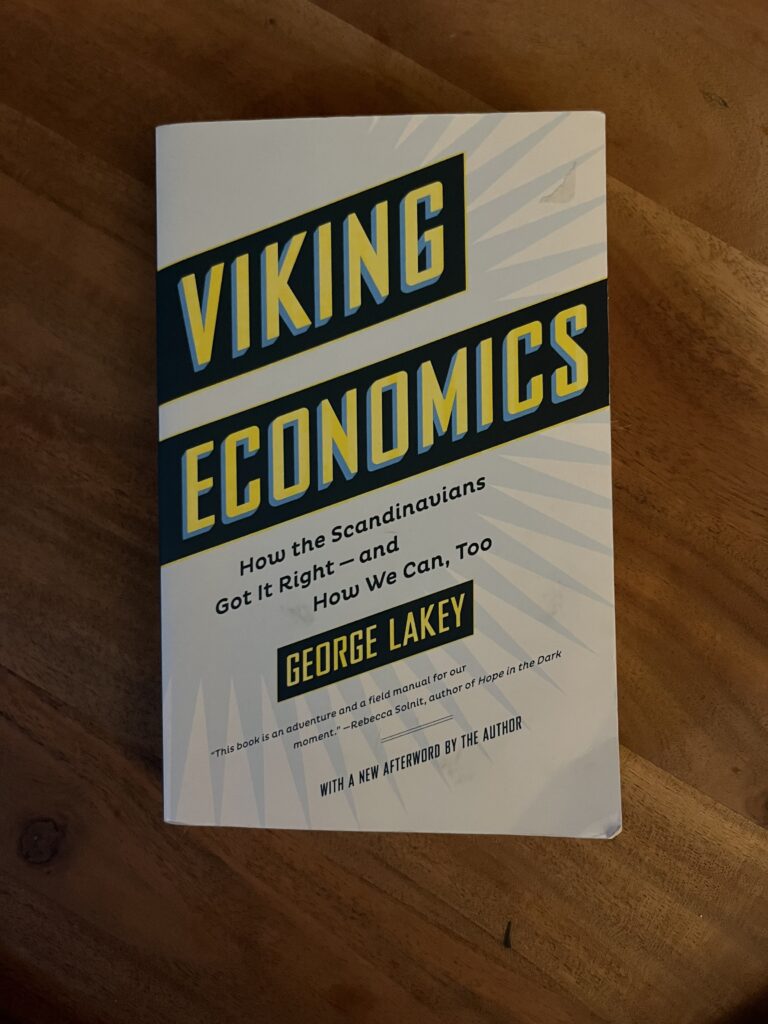
That’s not to deny that the Nordic economies have their problems. Following the Great Recession of 2008, Iceland practically imploded due to the bad investments of its banking sector. In Norway, where the discovery of oil in the 1970s led to the creation of a sovereign wealth fund seeded with money from the production of fossil fuels, climate change presents acute challenges. And in Sweden and Denmark, cultural conflicts over immigration have fueled the rise of far-right parties who have used the welfare state as a wedge issue to turn working-class voters against new immigrants, who are portrayed as a drag on the countries’ public services. However, as George Lakey argues in his 2017 book Viking Economics: How the Scandinavians Got it Right—and How We Can, Too, despite these problems, “the Nordic model” is still worth emulating. In accessible prose and a conversational—one could almost say breezy—style, Lakey describes how the Nordic social democracies developed, what makes them thrive, and what they can teach the rest of the world.
Class Struggle and the Birth of the Nordic Model
One of the most valuable parts of Lakey’s discussion is his history of the Nordic model, which occupies a big chunk of the first part of the book. As skeptics of applying Nordic principles to the American economy often imply, the model can seem a natural correlate of Nordic culture, something in these countries’ DNA, as it were, and thus hard for other countries to replicate. What Lakey shows, however, is that although the bold adventuring spirit of the Viking past has played a role in the development of the Nordic social democracies, their history is quite recent, the product of the late nineteenth and early twentieth centuries.
Before then, Nordic societies were poor and unequal, mired in the same outmoded social customs and hierarchies as much of the rest of Europe. During the nineteenth century, many Scandinavians immigrated to North America in search of greater opportunity. The decision to adopt social democratic policies, leading to the creation of a strong welfare state, high-levels of equality, a much-diminished and chastened class of aristocrats and wealthy capitalists, and broadly shared prosperity was the outcome of social conflict and pressure from below in the form of a growing labor movement and nonviolent mass strikes that attracted broad social support. As Lakey shows in the case of Norway, the Nordic country he knows best, a militant workers’ movement that flirted openly with communism was key to the creation of a strong social democratic culture in which the power of owners was checked by democratic institutions that applied not just to the polity but also to the workplace. This history suggests that the Nordic model has less to do with “cultural DNA” than with class struggle and social movement organizing.
What Makes the Nordic Model Special?
In the second part of the book, Lakey moves beyond history to look at the institutions and ideas that underpin the Nordic model in greater detail, focusing on the areas of gender equality, work-life balance, poverty, taxes, education, racism, and efforts to combat global warming. While Lakey cites impressive initiatives in all these policy areas, I was especially interested in his discussions of work-life balance, poverty, and taxes. These topics comprise core aspects of the economy which affect large swathes of the population and are the areas where the U.S. has the most to learn from the Nordic countries, in my opinion. That’s not to say there isn’t much to learn in the other areas, whose importance must not be underestimated; but the Nordic emphasis on collective bargaining and a welfare state that provides universal services through the public rather than the private marketplace represents one of the most dramatic contrasts between the Nordic and the U.S. models.
Lakey’s discussion of these areas is illuminating. Americans have good reason to be jealous of the generous paid vacation time that Nordic workers enjoy (roughly five weeks), their guaranteed health insurance, which they get independent of employment, and the active labor market policies that ensure workers are matched with jobs that best suit their talents and interests. Although the Nordic tax burden may appear onerous from a U.S. perspective, it enjoys widespread support because of the high-quality services it finances. Yet I couldn’t help feeling that Lakey was sometimes bending over backwards to accommodate dubious U.S. assumptions about the sanctity of work and private initiative even as he extolled the Nordic rejection of “neoliberal” market logic.
Take work. Lakey emphasizes the Nordic respect for work as a key driver of their success in reducing poverty. For example, in a section entitled “The Central Role of Work In Anti-Poverty Strategy,” Lakey writes: “For the Norwegians’ economic design, paid work is fundamental” (p. 128). While I wouldn’t dispute that assertion per se, I would argue that Lakey could have emphasized more clearly that the Nordic economies succeed in reducing poverty by distributing income through the welfare state rather than exclusively through the market mechanism of “factor income,” which distributes income based on things like rents, profits, and wages. As policy analyst and Nordic welfare state connoisseur Matt Bruenig argues, meeting the needs of people who can’t earn factor income because they don’t own assets and can’t work (because they belong to a core category of nonworkers: children, retired people, the disabled, the unemployed, students, and caretakers) is key to reducing poverty. “People who do not generally study poverty often erroneously believe that the answer to poverty is more jobs and higher wages,” Bruenig writes. “This is not surprising because this is the major poverty narrative of [U.S.] society. But this strategy runs into a wall very quickly” because “poverty afflicts nonworkers.” The reliance on the welfare state, which distributes income apart from work, is a big part of what makes the Nordic model successful and is something we should emulate here in the U.S. To his credit, Lakey does emphasize the importance of universal social programs to the Nordic model, which provide key services like healthcare, education, and childcare for all irrespective of income or employment status.
Lakey also emphasizes the role of cooperatives in the Nordic economies, taking pains to show the size and importance of this sector within the overall model. While I have nothing against co-ops and would welcome their spread in the United States, I wondered why Lakey didn’t also stress the role of state ownership in the Nordic model, a phrase that appears nowhere in the book, according to a Kindle keyword search. (Lakey does mention that Norway is home to “the largest sovereign wealth fund in the world,” but only in passing in his discussion of climate change.) Once again, Bruenig’s work is insightful. As he has discussed at length, the Nordic economies are characterized by a high degree of public ownership, often exceeding the levels of state ownership in more nominally socialistic countries such as Venezuela. I was also surprised that Lakey did not mention the Meidner Plan, an ambitious proposal by Sweden’s labor unions to socialize the country’s economy through wage-earner funds.
Another weakness of the book is its near total neglect of Finland. While technically not a Scandinavian country due to its geography and language, Finland is still considered a Nordic country, and its economy includes many of the same institutions that make the other Nordic countries stand out. Fortunately, readers interested in Finland can pick up The Nordic Theory of Everything by Finnish American journalist Anu Partanen, which complements Lakey’s book well.
Why the Nordic Model Isn’t Just for the Nordics
Aside from the history it tells, the main strength of Viking Economics is its concluding discussion of why the Nordic model is generalizable beyond the borders of the Nordic countries. Lakey organizes this discussion as a Q&A, answering the questions he has heard most frequently in the talks that he has given on the virtues of the Nordic economies. Common talking points against applying Nordic principles in the U.S. include the fact that the Nordic countries are small and have homogenous populations, whereas the U.S. is big and diverse. As Lakey points out, however, small size is generally considered a disadvantage when it comes to economics. “A big and wealthy country like ours can take on many projects that are beyond the reach of smaller countries,” he writes. “There are many ways in which the United States could use its advantages of scale to exceed the achievements of the Nordics” ( p. 245-6). And on the question of homogeneity, it’s not clear how it is relevant to providing things like free public higher education. As Lakey points out, New York City, a very diverse place, once offered free public higher ed. The contrast between Spain and Portugal provides another counterexample to the homogeneity and size talking points. Portugal is smaller and more homogenous than Spain, yet it is poorer and more unequal. One could go on, but these examples should give a taste of how Lakey addresses common arguments against importing the Nordic model to the U.S.
Finally, Lakey is at his best when explaining how nonviolent mass protest can achieve progressive change. As he compellingly shows, this is what happened in countries like Norway in the early 20th century and Iceland after the 2008 economic collapse. Lakey combines his pacifist beliefs as a Quaker with myriad examples of social reform from the 1930s and 1960s to make a persuasive case that well-organized social movements using peaceful tactics are the best vehicle for lasting change. Such movements offer a glimmer of hope in our dystopian present: It is often when countries are most polarized that grassroots change can occur most rapidly. “Just as in the Nordic countries in the 1920s and ’30s, the legitimacy of the U.S. political economy is shredding,” Lakey writes. “Now, because legitimacy has eroded, we can go well beyond the piecemeal reforms yielded in the ’60s that kept the power structure in place” (p. 264). The damage and further polarization sure to be inflicted by the second Trump administration offer a chance to test this idea—and an incentive to prove it right.