On November 11, 1887, August Spies, Albert Parsons, George Engel, and Adolph Fisher were hanged for their alleged role in the deadly Haymarket bombing, which occurred at a labor rally in support of the 8-hr workday in Chicago on May 4 the previous year. Although the identity of the bomb thrower was never established, Spies, Parsons, Engel, Fisher, and four others were tried for murder on the theory that their anarchistic ideas and activism, if not their direct actions, were to blame for the bombing. The trial came to be regarded as a travesty of justice; in 1893, Illinois governor John Altgeld pardoned the three surviving defendants.
In a forthcoming essay for the Newberry Library’s Digital Collections for the Classroom project, I discuss the effects of Haymarket on Chicago‘s Jewish immigrant community within the broader context of the city’s Jewish working-class history. (Update: the essay is now online.) Jewish immigrants from Eastern Europe, who began arriving in Chicago in large numbers just a few years earlier, were not directly involved in the events of Haymarket; nevertheless, they were profoundly influenced by them. (While Eastern European Jewish immigrants weren’t directly involved, it is notable that two of the lawyers who defended the accused Haymarket anarchists were Jewish, and one of them, Sigmund Zeisler, was a recent German-speaking immigrant from Austria.) For Abraham Bisno, a Jewish garment worker from Ukraine, Haymarket was a formative experience. A month before the bombing in April 1886, Bisno saw Spies give a German speech to a group of workers, which as a native Yiddish speaker he could understand. By his own account, the speech set Bisno’s mind “aflame” and opened his eyes to the nature of capitalism as an unjust, historically transient, class-based system that could be overcome through conscious social action. On May 5, 1886—one day after the bombing—Bisno and other Jewish tailors organized a march to demand better wages and working conditions. The procession was violently suppressed by the police as it crossed the Van Buren Street Bridge. In his autobiography, Bisno described the state of “martial law” that prevailed in the aftermath of Haymarket: “Labor unions were raided, broken up, their property confiscated, the police used their clubs freely. Arrests were made without any cause, and the life of the working man was not quite safe when out on strike.” Shaken but undeterred, Bisno and his comrades went on to organize the Chicago Cloakmakers’ Union, a forerunner of the International Ladies Garment Workers’ Union; in 1890, Bisno was elected the union’s first president.
Haymarket also made a strong impression on Philip Bregstone, a Jewish immigrant from a small town in what is today Lithuania (then Poland). Bregstone arrived in Chicago in the summer of 1887. The city was still reeling in the aftermath of the bombing and trial, and the defendants were still fighting their convictions in appeals court. Impressed by Spies’s fiery oratory, Bregstone said that he “hurled bombs at his enemy, the capitalistic class, not made of explosive chemicals, but bombs of logic and science” and “was an orator of dynamic force” who “spoke equally well in English and German.” In his 1933 cultural history, Chicago and Its Jews, Bregstone described how Haymarket planted the seeds for the city’s Jewish labor movement, leading directly to the formation of the Jewish Workingmen’s Educational Society. “It was there that the Jewish labor movement, Jewish radicalism, socialism and anarchism in this city, first saw the light of the day,” Bregstone wrote. The organization “established a modest library, conducted lectures and encouraged public speaking.” Bisno was one of the society’s leading members, as was Peter Sissman, a prominent socialist, lawyer, and associate of celebrated civil rights attorney Clarence Darrow.
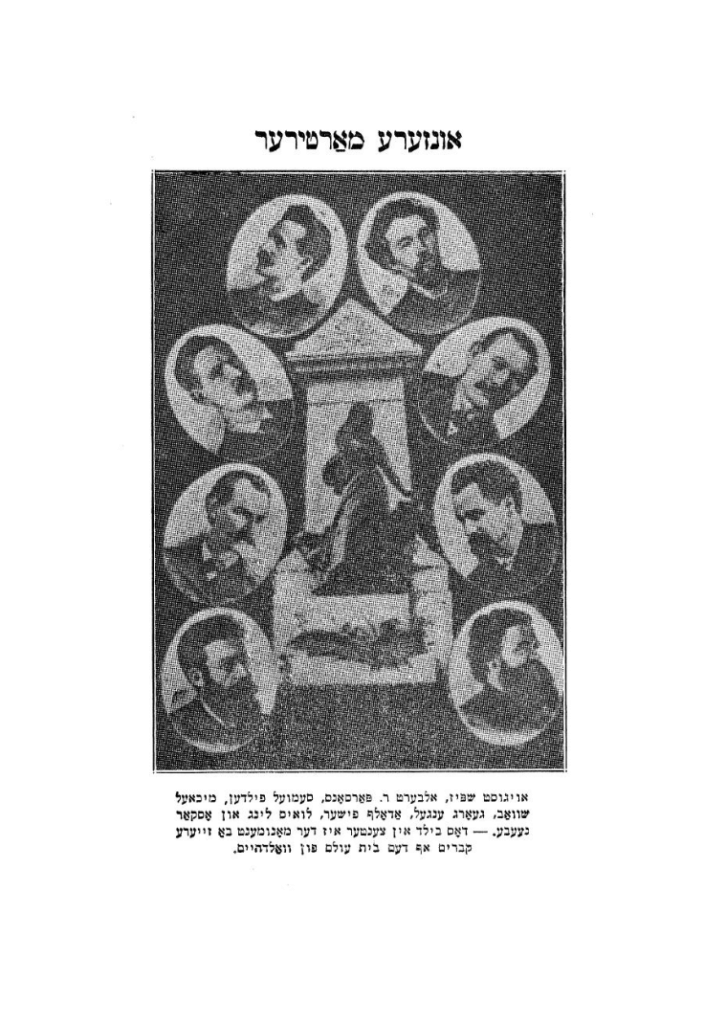
For Hilda Polacheck, who arrived in Chicago from Poland in 1892, several years after the events of Haymarket, the episode had already acquired an almost mythic status. In her memoir, she describes attending a Haymarket memorial meeting led by anarchist and fellow Jewish immigrant Emma Goldman in 1903. As an immigrant forced to work long hours in a knitting factory to support her family after her father died, Polacheck related to the events of Haymarket personally. “As I sat there listening to the recital of these events, I kept thinking of the shirtwaist factory and the hours I worked, and I could not get myself to feel that asking for the eight-hour day was a crime,” she wrote. Although she “was horrified at the throwing of the bomb” she was equally shocked by the state’s brutal suppression of labor activists. Her “father had come to America … because here in this wonderful country a man was free to say what he wanted, even if he was wrong.”
138 years later, the issues that animated the Haymarket affair and its aftermath remain relevant. People are still overworked and underpaid, immigrants continue to have their civil rights abused, and authoritarian politicians continue to threaten freedom of speech. At the turn of the twentieth century, members of Chicago’s Jewish immigrant working-class reacted to such abuses and indignities by joining with others to form a broad movement for democracy and labor and civil rights. For example, Bisno and Polacheck formed close relationships with Jane Addams and Hull House, forging coalitions to pass labor laws and support strikes from the 1890s through the 1910s, activities that helped pave the way for the social democratic reforms of the New Deal era. Their motivations were decidedly secular and political rather than spiritual or religious, yet Chicago’s working-class Jewish immigrants were still informed by a broader Jewish consciousness, which Emma Goldman alluded to when she said of the Haymarket affair, in Polacheck’s recollection, “that everybody in the hall knew the story of the martyred comrades, but like the story of the Exodus, it had to be told each year so that ‘we will not forget.’” Rather than looking to messiahs or prophets, however, they looked to themselves and their fellows to make a better world.